Showing posts with label Ecuador. Show all posts

Sunday, May 8, 2011

Francois Pralus: Equateur


I regret that I haven't blogged in over a month. The truth is, I'm graduating from college in two short weeks, and between securing an apartment rental and tying up some end-of-semester loose ends, I've fallen behind on all kinds of things. Plus, I've been battling a really annoying cold for the past week, and I've had quite an appetite for soup but little else. Chocolate helps in times of laughter and song, and in times of heartache and sorrow -- but not really so much in times of congestion and post-nasal drip.

Francois Pralus: Equateur
Cocoa content: 75%
Notable ingredients: n/a
Origin: Ecuador

Michael got me this chocolate bar at the Murray's cheese kiosk in Grand Central Marketplace several weeks ago. Francois Pralus has appeared on this blog once before. He makes a bar from Indonesian cocoa beans ("Djakarta") which I found to be pretty delicious and well-made. Emphasis on the well-made -- these bars are extremely snappy, texturally consistent, and overall very well balanced. Equateur has a great cocoa content and just the right amount of added sugar. Like most serious single origin bars though, it's a little bit un-fun.

The new neighborhood I'm moving to has plenty of great chocolate, so I hope to find many more bars to write about. I'm just about 10 blocks away from my favorite chocolate store in New York, so the only obstacle will be time and money. These bars are expensive. Luckily, I'm well prepared for the next several weeks. I've got two beautiful, salty bars from New Hampshire, and one bar with a heretofore unseen mix-in. Let's hope I find some time to write.

This bar gets a B.

Saturday, February 12, 2011

Jacques Torres: Bean to Bar


I got this bar at the Jacques Torres store in Chelsea Market -- if you haven't been there, it's definitely worth visiting. There is a huge variety of chocolate goods in the tiny area where he has his kiosk: a counter case of truffles, chocolate-covered cookies and cheerios and fruits and nuts, cookies, and the entire line of bars. I've tried a bunch of JT's blended bars but I'd actually never seen the bean-to-bar bar before. Apparently he debuted it along with the opening of his Chelsea Market location, which was in 2009.

Jacques Torres: Bean to Bar
Cocoa content: 70%
Notable ingredients: n/a
Origin: n/a

It's interesting that this bar has no single origin. The bean-to-bar label simply indicates that JT starts the chocolate-making process with the dry cocoa beans. Most chocolate-makers only participate in part of the process: they buy the cocoa fully roasted and blended and then add whatever sweeteners or ingredients they want before packaging the bar. You would think that if a company is sourcing the beans directly, they would buy them from one region. But I guess the blend of beans that he uses in this bar: Ghana, Ecuador, and the Ivory Coast, demonstrates a deliberateness of flavor that some single origin bars are lacking.

Everything about this bar is near-perfect. The consistency is pure and smooth, the taste is kind of bright and fruity, and there is a perfect balance of sweetness for a 70% bar. It doesn't suffer from typical bean-to-bar hubris, where the purity of the chocolate is so emphasized that the taste of the bar is forgotten.

Next week: bringing back everybody's favorite nut. A-

Saturday, January 15, 2011

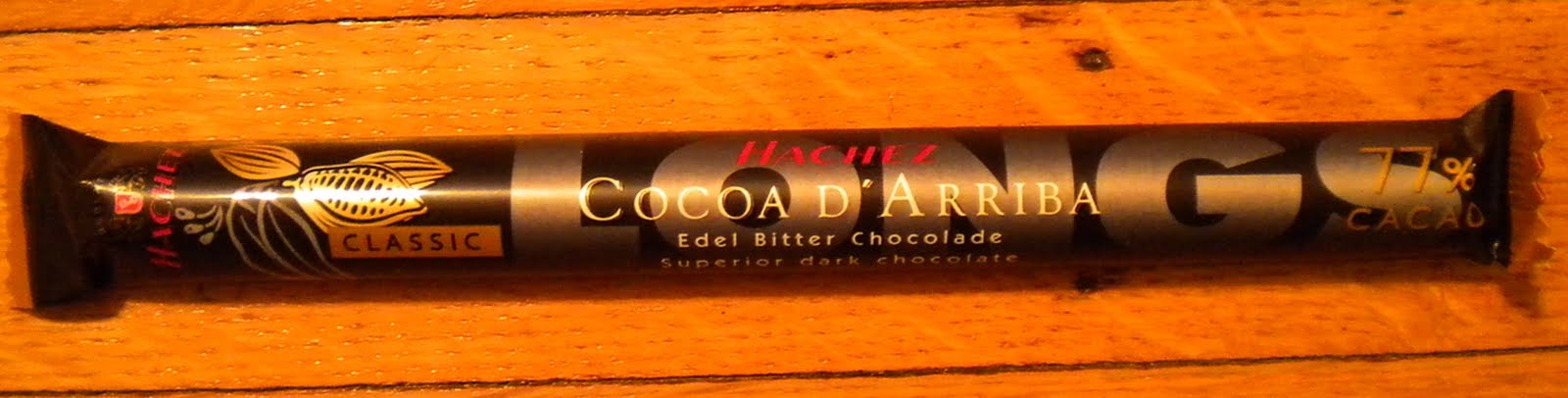
Hachez: Cocoa D'Arriba 77% Longs


My mom brought this elegant thing home from Eden Gourmet, and we quibbled over whether it fit the requirements of my blog. The truth is, I'm here to blog about chocolate bars and lord knows I don't blog about chocolate truffles, candies, or bonbons -- let alone tubes, mom! But since I'm not one to look a gift horse in the mouth, I decided to eat this slender treasure, and I am here today to tell its tale.

Hachez: Cocoa D'Arriba 77% Longs
Cocoa content: 77%
Notable ingredients: n/a
Origin: Ecuador

The bar is about 8 inches long and half an inch across, and it's segmented into little inch-long pieces, which break off with impressive snap. The chocolate itself is decent but not all that interesting: South American chocolates usually avoid the unpleasant acidic notes that you find in African single origins, but this bar seems to have sacrificed layers of flavor for a smooth finish. It tasted clean and satisfyingly melty, but the taste was no more interesting or distinctive than your average blended bar.

And -- I still have issues with the shape. This bar apparently belongs to a family of Hachez bars called Longs. Doesn't that seem like an arbitrary shape for chocolates? It's pretty -- sort of -- but it also breaks easily in your shopping bag and actually contains only about 1 1/3 oz. of chocolate. This bar can appear on the blog (you're welcome, you're welcome) but I'm thrilled with neither the chocolate nor the length of it.

Next week, back to New York, back to quality chocolate shopping. This bar gets a B.

Friday, December 24, 2010

Askinosie: San Jose Del Tambo


Doesn't that guy on the Askinosie bar look kind of like George W. Bush? My mom brought this bar back for me from Boston -- I think she got it at Formaggio, on Huron Ave. in Cambridge. I've seen these bars around before but I've never had one because they're pretty expensive. Thanks Mom!

Askinosie: San Jose Del Tambo
Cocoa content: 70%
Notable ingredients: n/a
Origin: Ecuador

I think Askinosie copied my blog. Look at the wrapper: categories for Bean, Origin, Variety, Cocoa, Process, and Choc-o-lot #. They basically stole my idea of summing up chocolate bars in a few simple categories, and went crazy with it. Honestly, who is going to recognize the names of different beans and bean varietals when they're shopping for chocolate bars? And who cares about the choc-o-lot #? What is that? Mine is just stamped with 05 06 10, which I assume is a date. But what am I supposed to make of that?

I wish I could dock points for this excess, but I can't: this bar was too delicious. It had a perfect snap, great consistency, and a sweet, roasted coffee flavor -- not at all acidic. This is one of the better South American single-origin bars that I've tried.

Another thing: it comes in this adorable little bag. I don't know if you can tell from the picture, but the wrapper is actually a narrow little brown paper bag, folded over at the top and tied shut with twine. The front is stamped with bar-specific statistics and the back is printed with a little note from the founder, Shawn Askinosie -- oh, ok, so reading this now I see that the picture on the front is of the farmer. No kidding! So it's not George W. Bush.

This was a great bar and I can't wait to eat another Askinosie bar. Next up, if I can find it in New York: the Malted Moo Moo bar. Yum. B+.

Thursday, March 4, 2010

The Tea Room: Mate & Cacao Nibs


This picture doesn't even capture how pretty the box was for this bar -- bright orange, with little raised letters and images. Michael got it for me at Cardullo's in Harvard Square, which is one of the best specialty food shops I know of. Plus, I saw Ben Affleck there once -- I bet I've already written about that on this blog. How embarrassing. This is the first tea infused bar I've ever had. It may or may not be the last:

The Tea Room: Mate & Cacao Nibs
Cocoa content: 72%
Notable ingredients: green yerba mate tea; nibs
Origin: Ecuador

Those who know me know that I am really not a tea drinker, but that has little to do with flavor and everything to do with my aversion to hot water. Unless it's pouring down over my body from a spigot, I want nothing to do with it. Anyway, of the teas that I do sometimes drink, green teas are not among them, so I wasn't too optimistic about the taste of this bar. I do enjoy nibs, however, which are just little bits of unground roasted cacao bean. They create a pleasant crunch and a slightly burnt taste, which I enjoy.

Sadly, I didn't encounter any nibs on my journey through this bar. Maybe they were too fine for me to detect, but if that's the case -- why bother? The rapture of nibs relies mainly on that crunch, so when the crunch is missing it's kind of a wasted ingredient. Which brings me to the tea. Maybe it's just because I'm not so into tea and haven't therefore Known it, but I really didn't taste anything that was distinctly tea-like. Maybe it was kind of bitter, but so is most single-origin dark chocolate. And anyway, what does green tea taste like? Grass, right? Would you infuse chocolate with grass?

I can only conclude that the high point of this bar was its box. And really, the bar itself wasn't bad: it probably would have been worse if it had tasted like tea. But instead it was just a decent single origin bar with a beautiful box and a misleading mention of nibs.

I most likely wouldn't return to this bar but I'm willing to give other tea infusions a chance just because I feel that green tea is the bottom of the barrel, and other teas might produce a better flavor. I give it a B-.

Wednesday, August 19, 2009

Vere: Banana & Macadamia Nut


This bar was bequeathed to me by my friend Molly of All or Nothing Thinking. It was purchased at Integral Yoga Institute's natural foods store in the West Village. In case you can't read the little label sticker, it says "buy a bar get this one free" -- THANKS A LOT. But seriously, I was highly intrigued to receive a bar the make of which I had yet to encounter. And furthermore -- banana? macadamia nut? Be still my heart. This bar had a lot going on:

Vere: Banana & Macadamia Nut
Cocoa content: 75%
Notable ingredients: bananas, macadamia nuts
Origin: Ecuador

This is the first bar that, as far as I've noticed, bills itself as vegan in the nutritional information. Soy lecithin is an ingredient, and I'm pretty sure I've seen that in other bars that didn't call themselves vegan before. I'm not sure if this bar is any different from other bars that I've had that contain soy lecithin but don't call themselves vegan, so I won't attribute any of its missteps to that label. Not that there's anything wrong with veganism, but I think most of us can agree that vegan confections often leave something to be desired.

I'm not sure why banana seemed so great to me as an ingredient. Upon actually eating this bar, I realized that it's the texture of the banana that so lends itself to chocolate -- not as much the flavor, although that works too. But when the flavor is totally separated from the texture, and as subtly represented as it is here, the usually winning companionship doesn't really do it for me. And the macadamia nuts -- where were they? I can't stand bars that have pulverized the mix-ins so much that they don't interrupt the consistency of the blend. I like things with mass -- chunks, slivers, halves, wholes, drops, crumbs, slices -- I like those things.

But my real qualms with the bar are twofold: the texture is heavily aerated, almost crackly upon biting, which leaves it with no real snap to speak of. And the taste confirmed my fears about many single origin bars: that they will be too bitter, too acidic, really too showy and authentic to actually be enjoyable. This bar could have used some better conching and -- hey, how about a banana chip or three? 

Although I acknowledge with curiosity that at least two people who have tasted this bar thought it was excellent, I can't betray my heart. I give it a C-.

Tuesday, July 21, 2009

Fine & Raw: 83%


This bar was given to me by my cousin Margaret, of Margaret Are You Grieving? Fine & Raw is a small company in Brooklyn. We will discuss what "raw" means. First, the stats:

Fine & Raw: 83%
Cocoa content: 83%
Notable ingredients: agave
Origin: Ecuador

The raw food movement is an eating/lifestyle trend that emphasizes uncooked -- or very lightly cooked -- foods for health reasons. But there's also a sort of snobbery to raw foodism, because uncooked and unprocessed foods are "close to the earth," and usually pretty expensive. Raw chocolate is no different, really: Fine & Raw uses ambiguous "artisan low heat techniques" and they avoid additives like dairy and sugar. They skip the conching process, which improves the creamy texture of chocolate. 

Again, Fine & Raw doesn't add sugar -- by which I mean cane, or corn syrup, or anything like that. They do use a natural sweetener called agave nectar, which is kind of like honey and is popular among vegans because it comes from a plant rather than an insect. Agave tastes pretty much like any other sweetener, especially here because it is in such a small amount.

This chocolate really wasn't that fabulous because the point of raw food isn't taste or indulgence. This would be of more interest to people who are really excited by organic candy and cooking processes that interfere with the ingredients as little as possible. In my case, I'm not so concerned with those things because at the end of the day, all I want is to have known delicious chocolates. This bar's rating gets bumped up slightly for the pretty packaging, to a B.