Showing posts with label single origin. Show all posts

Saturday, July 23, 2011

Alter Eco: Dark Quinoa


I had big plans for this blog post -- had those plans not been derailed by graduation, employment, and an obscene heat that is entirely inhospitable to chocolate eating, this post would have arrived sometime in April -- it would have documented a curious intersection of contemporary food trends and the Exodus of the ancient Israelites -- yes, that Exodus, which Passover commemorates.

Alter Eco: Dark Quinoa
Cocoa content: 61%
Notable ingredients: rice-quinoa crisps
Origin: Bolivia

So, remember a few months ago, when the weather actually allowed for breathing and long pants, when we gathered around the table to nibble on bitter herbs and denounce chametz, a few of us were obsessed with this New Agey (and yet still, ultra Jewy) question -- is quinoa Kosher for Passover? I don't think we ever really got a definitive answer, but that question stoked my interest in this bar. And then I let it sit on a shelf for a few months. That seems to be happening a lot around here recently.

Three months later, this bar represents nothing more than another chapter in the long tradition of rice crisps masquerading as other things in chocolate bars. Given that this company -- Alter Eco Fair Trade -- actually sells plain old quinoa sourced from Bolivia in addition to chocolate, I was expecting crunchy little pseudocereals instead of these uninspired rice puffs. Ok -- granted -- quinoa rice puffs -- but still, this bar was no more distinctive than your average Nestle Crunch bar.

Next week, another selection inspired by the days of yore -- perhaps not so yore as the release of the Israelite slaves from Egypt, but pretty yore nonetheless. This guy gets a C.

Saturday, July 2, 2011

Mast Brothers Factory Tour Pt. 1

I know that I'm only supposed to write about chocolate bars here, and I know that to write about anything else I risk compromising the mission--and with it, the very integrity--of Chocolates I Have Known. And I do want to write about chocolate bars, but today I've come to discuss how they are born--not their taste, nor their distinctive features, nor their hubristic missteps of design--well, maybe I will talk about those things, too.

Last week I went on a tour of the Mast Brothers chocolate factory, located on a quiet block near the waterfront in Williamsburg. This blog has Known the Mast Brothers before--it's a rather new company owned by two brothers, one formerly of Gramercy Tavern and one formerly of Jacques Torres's Manhattan factory. They make mostly single-origin chocolates, and they exclusively use organically-farmed cocoa in all of their products.

The first thing we did upon arrival at the factory was we sat as a group at a table in the front room, adjacent to the storefront area where chocolate bars, nibs, chips, and baker's bags are sold. A whimsical fellow named Ian passed around a couple of dried cocoa pods, which are the vessels that house the cocoa fruit in which the beans are lodged. He explained to us the difference between Criollo and Trinitario beans, both of which the brothers use in their product. Then he handed us hairnets and we were on our way into the factory.

Out front, behind the sales table, a few men were preparing the chocolate bars to be wrapped. After cooling into their bar-shaped molds, the chocolate bars are set on wire trays, and the men pick up each bar, wrap it in gold foil (or as our tour guide said, plainly "gold,") and sets it in a pile to later be wrapped in patterned paper by a team of volunteers. They work alongside a couple men who sort through newly arrived beans, aiming to remove stones and little bits of debris from the beans before they are processed in the factory. One time, they found a lizard's heard.

Beyond this group, the conching process takes place in a loud, hot room. The chocolate is spun with sugar in metal vats for three days, breaking down in the heat created by the friction. It spins for three days.

When it's entirely broken down, it sits and ages for a month in a second metal vat. It develops a chalky, textured patina and allegedly develops in flavor during this time. Ian said that the chocolate would taste "green" if it went straight into bars before being aged.

Upon fully aging, the chocolate is re-melted in a brief tempering process, after which it is set into chocolate bar molds, dressed with various nuts and other dressings as applicable, cooled in a refrigerator, and set on a wire tray to then be wrapped in gold foil by the gentleman out front. The birth of a chocolate bar in this factory is a thing that begins and ends on the same table.

You know from reading my previous blog posts that I have not been absolutely crazy about Mast Brothers chocolates. I taste the care and deliberateness that goes into the production of each one, but I still haven't found any of these flavors to be absolutely delicious--and sweet and forgiving--and fun--the way the best chocolate is, I think. Taking this tour, I recognized and appreciated the company's sincerity at every step of the way. They don't cut any corners and they clearly do things the way they know is the right way, with no exceptions. I like companies like that--I work for one. But maybe sometimes the "right way" is more of a romantic flourish than a studied pursuit of flavor--we are in Williamsburg here, after all. For instance, Ian told the group that just a few days earlier, the Mast Brothers had sailed in with something like 20 tons of cocoa beans from the Dominican Republic. On a sailboat. A schooner! Apparently it hasn't been done in like 70 years. Safe? No. Precedented? No. Cost-effective? Please! But romantic, right? The Mast Brothers have a vision of how things should be done, and they stick to that vision. More than ever, I wish I loved their chocolate.

Sunday, May 8, 2011

Francois Pralus: Equateur


I regret that I haven't blogged in over a month. The truth is, I'm graduating from college in two short weeks, and between securing an apartment rental and tying up some end-of-semester loose ends, I've fallen behind on all kinds of things. Plus, I've been battling a really annoying cold for the past week, and I've had quite an appetite for soup but little else. Chocolate helps in times of laughter and song, and in times of heartache and sorrow -- but not really so much in times of congestion and post-nasal drip.

Francois Pralus: Equateur
Cocoa content: 75%
Notable ingredients: n/a
Origin: Ecuador

Michael got me this chocolate bar at the Murray's cheese kiosk in Grand Central Marketplace several weeks ago. Francois Pralus has appeared on this blog once before. He makes a bar from Indonesian cocoa beans ("Djakarta") which I found to be pretty delicious and well-made. Emphasis on the well-made -- these bars are extremely snappy, texturally consistent, and overall very well balanced. Equateur has a great cocoa content and just the right amount of added sugar. Like most serious single origin bars though, it's a little bit un-fun.

The new neighborhood I'm moving to has plenty of great chocolate, so I hope to find many more bars to write about. I'm just about 10 blocks away from my favorite chocolate store in New York, so the only obstacle will be time and money. These bars are expensive. Luckily, I'm well prepared for the next several weeks. I've got two beautiful, salty bars from New Hampshire, and one bar with a heretofore unseen mix-in. Let's hope I find some time to write.

This bar gets a B.

Sunday, March 27, 2011

Madecasse: Sea Salt & Nibs


Mama bought me this chocolate bar. This is a company that I've seen around for a long time but it hasn't been on the blog yet. They just recently launched this new flavor -- the sea salt & nibs bar -- and I'll try anything salt-flavored at least once.

Madecasse: Sea Salt & Nibs
Cocoa content: 63%
Notable ingredients: sea salt, nibs
Origin: Madagascar

Madecasse is different from other chocolate companies. Ok, reading that, I sound like the promotional copy on the company website, but I'm actually just going to explain what distinguishes this company from the others so bear with me. A lot of fancy chocolate companies source their cocoa from a particular region -- that's what makes a chocolate single-origin. And a lot of chocolate companies source their cocoa from Madagascar -- there have been plenty on this blog. But Madecasse actually makes the chocolate in Madagascar. Or rather, they hire people to make the chocolate and then sell it out of New York, where their company is based. This creates 4x the income for the Madagascar laborers than there would be if they were only harvesting cocoa beans, and not producing the finished product.

So it's a humanitarian bar and it's a delicious bar, too. The nibs are roasted, cut large, and clustered on the bottom surface of the bar. The sea salt is ground coarsely but is distributed sparsely enough so as not to overwhelm the texture of the chocolate or the roasted flavor of the nibs. 63% is pretty nice for a chocolate bar, but I think this bar could have gone darker to better accommodate the heft of the nibs. There was a bounty of nibs!

Finally, I love a package that you tie closed with a bit of raffia. This bar gets an A-.

Saturday, March 12, 2011

Patric: PBJ OMG


I didn't take this picture. I don't lay my whole chocolate bar out on a plate like some kind of fool. But I left my own pictures of this beauty on my laptop, which is still is New York, and here I am in Boston. I got this bar at the Dean and Deluca on Broadway in Soho. I'm always hesitant to go in there because it's constantly packed, but I'm glad I did because they have some bars I've never seen before.

Patric: PBJ OMG
Cocoa content: Curiously unlisted* (I think 70%)
Notable ingredients: peanut butter
Origin: Unlisted, but might be Madagascar*

*The reason there is so little information about this bar is that it's a limited edition and it apparently sold out although Dean and Deluca still has them -- I may have gotten one of the last ones. I say Madagascar for the origin because that seems to be the typical base that Patric uses for bars with added ingredients.

Patric is a bean-to-bar chocolate company based in Missouri -- where, oddly, a bunch of chocolate companies live. The chocolatier is Patric McClure -- I assume he's the purple guy on the front of the bar. He only makes about 6 or 7 bars, most of which are single origin dark chocolate bars. This bar, the PBJ OMG, was released in October 2010. The concept is that the cocoa he uses has naturally occurring "jam-like" berry notes, so when the chocolate is combined with peanut butter it creates a peanut butter and jelly flavor.

But let me say one thing, if I might. For those chocolate eaters among us whose palates aren't subtle enough to pick up on these (allegedly "bursting") berry flavors, this chocolate bar was not so much a PBJ bar as a PB bar, and so it elicited not so much an OMG but rather an SMH. Compared with the Fresh Direct PBJ bar from 2 weeks ago, this bar had nothing really in common with the classic sandwich.

It was very good in its own way, though. The peanut butter is natural, the chocolate had a great, consistent texture (although it didn't have a great snap, but that might be due to the temperature in which I kept it,) and the bar had surprisingly little added sugar. Peanut butter and chocolate is always a successful combination, and the use of good ingredients here only helps the situation.

I have a few days to spend here, so my plan is to go out and find another bar we've never seen before. This one gets a B.

Saturday, January 15, 2011

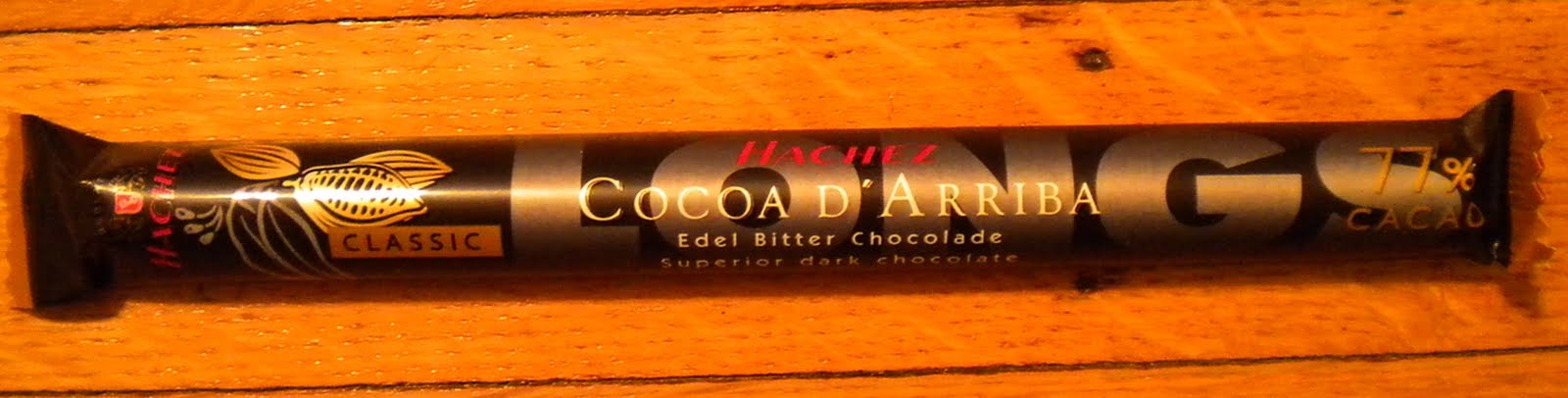
Hachez: Cocoa D'Arriba 77% Longs


My mom brought this elegant thing home from Eden Gourmet, and we quibbled over whether it fit the requirements of my blog. The truth is, I'm here to blog about chocolate bars and lord knows I don't blog about chocolate truffles, candies, or bonbons -- let alone tubes, mom! But since I'm not one to look a gift horse in the mouth, I decided to eat this slender treasure, and I am here today to tell its tale.

Hachez: Cocoa D'Arriba 77% Longs
Cocoa content: 77%
Notable ingredients: n/a
Origin: Ecuador

The bar is about 8 inches long and half an inch across, and it's segmented into little inch-long pieces, which break off with impressive snap. The chocolate itself is decent but not all that interesting: South American chocolates usually avoid the unpleasant acidic notes that you find in African single origins, but this bar seems to have sacrificed layers of flavor for a smooth finish. It tasted clean and satisfyingly melty, but the taste was no more interesting or distinctive than your average blended bar.

And -- I still have issues with the shape. This bar apparently belongs to a family of Hachez bars called Longs. Doesn't that seem like an arbitrary shape for chocolates? It's pretty -- sort of -- but it also breaks easily in your shopping bag and actually contains only about 1 1/3 oz. of chocolate. This bar can appear on the blog (you're welcome, you're welcome) but I'm thrilled with neither the chocolate nor the length of it.

Next week, back to New York, back to quality chocolate shopping. This bar gets a B.

Friday, December 24, 2010

Askinosie: San Jose Del Tambo


Doesn't that guy on the Askinosie bar look kind of like George W. Bush? My mom brought this bar back for me from Boston -- I think she got it at Formaggio, on Huron Ave. in Cambridge. I've seen these bars around before but I've never had one because they're pretty expensive. Thanks Mom!

Askinosie: San Jose Del Tambo
Cocoa content: 70%
Notable ingredients: n/a
Origin: Ecuador

I think Askinosie copied my blog. Look at the wrapper: categories for Bean, Origin, Variety, Cocoa, Process, and Choc-o-lot #. They basically stole my idea of summing up chocolate bars in a few simple categories, and went crazy with it. Honestly, who is going to recognize the names of different beans and bean varietals when they're shopping for chocolate bars? And who cares about the choc-o-lot #? What is that? Mine is just stamped with 05 06 10, which I assume is a date. But what am I supposed to make of that?

I wish I could dock points for this excess, but I can't: this bar was too delicious. It had a perfect snap, great consistency, and a sweet, roasted coffee flavor -- not at all acidic. This is one of the better South American single-origin bars that I've tried.

Another thing: it comes in this adorable little bag. I don't know if you can tell from the picture, but the wrapper is actually a narrow little brown paper bag, folded over at the top and tied shut with twine. The front is stamped with bar-specific statistics and the back is printed with a little note from the founder, Shawn Askinosie -- oh, ok, so reading this now I see that the picture on the front is of the farmer. No kidding! So it's not George W. Bush.

This was a great bar and I can't wait to eat another Askinosie bar. Next up, if I can find it in New York: the Malted Moo Moo bar. Yum. B+.

Friday, August 20, 2010

Lake Champlain: Tanzania


Lately, I've been having some trouble finding the time to really get to Know my bars. I Know not, and I have too little time to report -- what I don't Know. But thank God, some bars aren't really worth Knowing. I never waste too much time getting to Know those bars. Is that a sin?

It's not a sin, per say. But it's certainly an afront to Lake Champlain Chocolates, a company that deems its product worth Knowing.

Lake Champlain: Tanzania
Cocoa content: 75%
Notable ingredients: n/a
Origin: Tanzania

Who is responsible for this blunder: Lake Champlain, or the Tanzanians? I'm going to go with Lake Champlain, because not only did they produce this bar, but they also totally misrepresented it online: intense and creamy? Fruity and floral?

Readers, this bar tasting like nothing. It tasted like not a single thing under the sun. Granted, it wasn't exactly new, but having sat in a box for a few months is no excuse for the stunning lack of flavor. It was like -- no, it was not like anything -- but the experience of eating it recalled cardboard; cheap whole-wheat bread; the casing of a Reese's Cup, if there were not a trace of peanut butter involved.

So, what's worse, for a chocolate to taste distinctively bad, or to taste of nothing? I'm going to go the neutral road on this one because I've Known far, far worse than this boring misstep. C.

Tuesday, July 27, 2010

Amano: Jembrana


This was a bar passed between cousins under the table at a Vietnamese restaurant where the dessert menu was underwhelming (thanks Clio!) This was a bar made of beans from the cocoa trees at the foot of Balinese volcanoes. This was a bar that -- though thick, dense, and stone ground -- still melted on the tongue without a hint of graininess. And thus it so happened that I set this bar forth in a scattering of cocoa beans and readied it for the close-up it deserves. Just kidding! Photo credit goes to Amano.

Amano: Jembrana
Cocoa content: 30%
Notable ingredients: n/a
Origin: Bali

Amano is one of about a dozen bean-to-bar companies in the United States. They are based in the Salt Lake City area of Utah. The name means "by hand" and "heavenly field" in Italian and Japanese, respectively, and -- get this -- they couldn't be Fair Trade certified because that exchange model simply doesn't pay the farmers enough! The company's prices paid to farmers come out at about 3 times the London Cocoa Terminal Market average.

So, their chocolate ought to be really good to warrant that degree of boasting. It is. I haven't tried any of their other bars but I have been hanging on to a dark Venezuelan bar of theirs that was given to me a few months back. Yes, I'm that deep in gifted chocolate, poor me. This milk bar, which was lighter than usual at 30%, was every bit as creamy and melty and milky as a mass-market Belgian chocolate but with so much more going on flavor-wise. Notes of honey and flowers remained present long after the chocolate had melted -- at which point, usually only the sugar is detectable.

So, this was wonderful and I'm excited to try more of their chocolates. Thanks again to my cousin Clio, who is an amazing, successful pastry cook and who has probably known sweets better than all of us. A-.

Wednesday, July 14, 2010

Vosges: Enchanted Mushroom


Yes, readers, I went there -- into the land of dessert fungus, that is. Disclaimer #1 is that I got this bar for free at the oyster & chocolate event I attended last week, and Disclaimer #2 is that no chocolate-loving blogger in her right mind could be bribed into giving this nasty blunder a favorable review. Read on for the dirty details.

Vosges: Enchanted Mushroom
Cocoa content: 66%
Notable ingredients: Reishi mushrooms; walnuts
Origin: Dominican Republic

Pleasures want not to mingle with other pleasures -- hasn't Vosges ever heard "too much of a good thing," and so on, and so on? Yes, mushrooms are delicious, with other savory foods. But upon being dried, powdered, and distributed throughout a perfectly good dark single-origin chocolate bar, they kind of lose their identity and start to feel showy, unknowable, unwelcome.

That's how they felt to me, anyway -- when you eat a chocolate bar, you're inevitably not tuned into the savory flavors that grace your dinner table: chili peppers, maybe; bacon, maybe, but that's because those foods have such strong flavor profiles that we know them distinctly as flavors, and not as composed dishes. Mushrooms, on the other hand, I think are too firmly defined as savory food. We have a range of ways we're expecting to experience them, and when we encounter them outside of that range, it's too hard to abstract from what our palates are used to.

In simpler terms, this bar was fucking gross and if I had paid money for it I would want my money back. Don't put anymore mushrooms in my candy bars, you fools. D.

Tuesday, June 29, 2010

Taza: Cacao Puro


This post doubles as a chocolate bar review and an event review -- the event being the UnFancy Food Show, which took place in Gowanus this past weekend. Organic, single-origin cocoa ground in traditional Mexican stone mills? Sounds pretty fancy to me, readers, but that's just one chocolate knower's opinion. Anyway, the fact that this bar is getting reviewed this week means it won out over several other, more local chocolate purveyors. More on that below.

Taza: Cacao Puro
Cocoa content: 55%
Notable ingredients: NONE!*
Origin: Dominican Republic

*So, why the big deal about none of the ingredients being notable? Really, the ingredients are kind of notable compared to most ingredients found in unfancy -- I mean literally unfancy -- chocolate bars; the beans are single origin Dominican, and ground only twice in a stone mill as opposed to a steel refiner. And the sugar is real cane sugar -- no relation whatsoever to corn. But.. that's it. This bar has only two ingredients. "The purest expression of our chocolate," says Taza's website. Glad to have known you so intimately!

Taza is a chocolate maker based in Somerville, MA, which is right near my hometown. As it happens, the guy who was working at the Taza booth was from Arlington, MA, and we had a nice little conversation about that. He encouraged me to try their special edition Chiapan bar, which was excellent -- but this blogger doesn't fuck with $9 treats, so I opted instead for a little disc of the Cacao Puro, at $4 a pop.

Cacao Puro is better than expected given that it is not cut with butter fat (one of my favorite things.) It's nice and sweet and the chocolate itself has a great flavor -- maybe not "wine-like," as the site purports, but nicely nutty and rich. Most Dominican beans are. The thing that irks me is the stone mill. I find the consistency of stone-milled chocolate too grainy, and insufficiently melty. This didn't interfere with my ability to enjoy the bar to the same extent that the Almond bar did, but still I prefer something a little creamier and neater.

I told you I was going to kvetch about the other chocolate makers represented at the UnFancy Food Show. Fine and Raw is -- sorry -- kind of nasty, and Nunu doesn't make chocolate bars (get with it!) Plus Taza had the Eastern MA connection appeal, and that's what I had to go with. The Food Show itself was really fun -- lots of wonderful pickled vegetables and homemade cheese and the best bloody Mary mix ever.

Interesting concept, adorable packaging, noble origins, but this bar gets a B.

Thursday, June 17, 2010

La Maison du Chocolat: Akosombo


It has been a slow week for chocolate consumption -- and thus a regrettably late blog post -- because I've been eating out a lot recently and, as such, have consistently left zero room for chocolate tasting after ordering many gluttonous desserts. Nevertheless, I've spent a few elegant nights with this bar from La Maison du Chocolat, which my mother gave me.

La Maison du Chocolat: Akosombo
Cocoa content: 68%
Notable ingredients: n/a
Origin: Ghana

La Maison du Chocolat is a French chocolate store with two locations in New York City -- Upper East Side and Rockefeller Center. They sell fancy, single-origin chocolate bars that are nearly impossible to photograph due to their color-contrasted text. Also, they cost like $18. Who's got duckets like that to spend on a candy bar? Thankfully, my mother.

I don't have a whole lot to say about this bar, and I have something so irresistible in the lineup for next week's entry that I'm kind of anxious to get on with it already. For something so presumptuously expensive, this chocolate was at best indistinct and at worst boorish and blundering. I mean -- it certainly wasn't bad, and the texture and snap were all of a reasonable quality, but there was just nothing interesting or striking about it. And I'll remind the reader that even the most seemingly simple concepts can be striking. Also -- single origin? I wouldn't have noticed.

So, THANKS MOM, love you forever, but the Akosombo bar just didn't blow me away. B-.

Wednesday, June 2, 2010

Mast Brothers: Almonds, Sea Salt, Olive Oil


What a beauty -- and made in Brooklyn! This bar, along with two other Mast Brothers bars, was given to me by my intuitive cousin just a week or so after I had admired it at the Murray's Cheese counter in Grand Central. Of course chocolate bars should be wrapped in gorgeous paper with fleurs de lis and anchors and leaves -- what is everyone else thinking? Mast Brothers consists of two brothers -- one of whom worked at Gramercy Tavern and at Jacques Torres's Manhattan factory. They make chocolate in Williamsburg. No surprise there.

Mast Brothers: Almonds, Sea Salt, Olive Oil
Cocoa content: 81%
Notable ingredients: almonds, sea salt, olive oil
Origin: Dominican Republic

Mast Brothers don't want you to think their chocolate is factory-made -- nor do they want you to consider the location of their (let's be honest) factory to be near the East River; they prefer "handmade in delicate batches" and "Brooklyn Channel," respectively. Also, they are one of the dozen companies that claim to be the only bean-to-bar chocolate maker in New York and they're starting a "chocolate revolution." They sell their bars at places like the Brooklyn Flea and Marlow & Sons and Spuytin Duyvil. The brothers travel around the world collecting cocoa beans.

The brothers are pretty serious about reminding you that each bar is personally handcrafted by one of them -- the bar's date of birth is even printed on the back label (mine was 3/24/2010.) For all the slow food branding it should be really, really special. And in a lot of ways, it was. The salt was effective and texturally interesting but not overwhelming, and the almonds were nicely crunchy and liberally distributed on the bottom surface of the bar. Olive oil was a good idea but I'm not sure it's really doing anything here -- salt and nuts can stand out in a bar of 81% chocolate, but most other flavors would get lost. The chocolate itself certainly tastes like a single origin and has a much better snap than most. It was intensely dark and muddy -- normally a higher percentage than I enjoy, but the salt really brightened every taste.

Mostly, the packaging is gorgeous and the bar truly looks like it was handmade by the very brother who scavenged the Dominican rainforest to bring home beans to his other brother. I look forward to trying the 72% single origin and the cocoa nib bar. This one gets a B+.

Thursday, May 20, 2010

Chuao: Firecracker


The other night I was relaxing in my chambers, watching Real Housewives (Danielle is a nutcase) when my mother shrieked in the other room because the dog got into the chocolate. See? A whole chunk was missing from the bottom left-hand corner before I even had a taste. Can you blame her? She just wants to do what I do! Unfortunately for her, though, dogs can't eat chocolate. She was ok in the end, but I have no doubt that this insane chocolate bar was a pretty weird trip for her. Read on.

Chuao: Firecracker
Cocoa content: 60%
Notable ingredients: chipotle; salt; popping candy
Origin: Venezuela

"A blooming, buzzing confusion" -- that's how William James characterized a baby's perception of the universe, and it aptly describes the experience of the Firecracker bar for a small, timid puppy such as my own. This bar was crazy, even for a human who's used to eating things like yogurt and whiskey encased in chocolate. I encountered popping candy (a.k.a. Pop Rocks) immediately in most bites, and they were the big pebbly kind that make an audible cracking noise. Each bite finished spicily with the chipotle, and the salt intensified everything -- as salt is want to do!

I'll never know how my dog experienced this bar because she doesn't blog. But I think it was a little too busy for my tastes. The chocolate is single origin but I could barely taste it amidst the chaos (the Chuaos?) Pop Rocks obliterate just about any other taste or texture, so they dominated the bar in an overwhelming way. Still, I had fun -- eating the bar and imagining what it might have been like for Wink.

I forgot to mention that I bought this bar at Food Emporium -- but I also received the same one from Dan days later. I want to assure all my readers that I now keep all my chocolate bars in a shoebox on my desk -- out of reach of all animals. All for me. B-.

Thursday, March 25, 2010

TCHO: Fruity

TCHO is a maker of chocolate -- exclusively dark, I've learned -- with an emphasis on single origin and fair trade products. My mother bought this bar for me at Whole Foods in Union, NJ, although most varietals of their chocolate are also sold at Starbucks locations, at least in the Northeast. Kiss of death -- am I right -- especially for a company that deems itself "obsessed," "innovative" and -- this is the worst -- "local." Local this chocolate is not, although I'm pretty sure what they mean to say is that they're the only chocolate manufacturer in San Francisco. So, sure, it's a local company, but that doesn't really mean much for the people who are buying their bars in a Starbucks in New York City. ANYWAYS:

TCHO: Fruity
Cocoa content: 68%
Notable ingredients: n/a
Origin: Peru

TCHO has created what they're referring to as a taxonomy of different chocolate flavors. All of the chocolate is dark, but the dark varies in terms of flavor notes, and TCHO has identified 6 recognizable taste groups. They are: Fruity (this bar); Floral; Earthy; Nutty; Chocolatey; and Citrus. The website elaborates on the flavors found in each category, and Fruity apparently tastes of cherry, raspberry, and raisin. And I actually found this to be remarkably true, although it's hard to say how much I was swayed by the "Fruity" label and the bright orange color on the box.

I do think the flavor was somewhat distinct from what Citrus might taste like: it wasn't at all sour or zesty. It was kind of sweeter than you'd expect a 68% cocoa to taste, and had a notably uplifting flavor, as opposed to those chocolates I've described as "earthy" on this blog. It tasted crisp, finished, and -- I don't know how to say this, other than "bright." I really think everyone should just go out and try this bar for themselves, because whether or not you can sense the variations in flavor it's really delicious and well-made. And it's widely available at a Starbucks near you -- or a Whole Foods. Plus, the snap was agreeable and the packaging is great.

Other flavors on the TCHO (by the way, this is pronounced "choh" and is meant to sound like the first syllable of "chocolate") taxonomy that I would want to try include Nutty and Citrus. And I'll throw in Chocolatey for good measure because that sounds right up my alley. This flavor seems like a good pick, though, so I applaud my mother and I give this bar an A.


Thursday, March 4, 2010

The Tea Room: Mate & Cacao Nibs


This picture doesn't even capture how pretty the box was for this bar -- bright orange, with little raised letters and images. Michael got it for me at Cardullo's in Harvard Square, which is one of the best specialty food shops I know of. Plus, I saw Ben Affleck there once -- I bet I've already written about that on this blog. How embarrassing. This is the first tea infused bar I've ever had. It may or may not be the last:

The Tea Room: Mate & Cacao Nibs
Cocoa content: 72%
Notable ingredients: green yerba mate tea; nibs
Origin: Ecuador

Those who know me know that I am really not a tea drinker, but that has little to do with flavor and everything to do with my aversion to hot water. Unless it's pouring down over my body from a spigot, I want nothing to do with it. Anyway, of the teas that I do sometimes drink, green teas are not among them, so I wasn't too optimistic about the taste of this bar. I do enjoy nibs, however, which are just little bits of unground roasted cacao bean. They create a pleasant crunch and a slightly burnt taste, which I enjoy.

Sadly, I didn't encounter any nibs on my journey through this bar. Maybe they were too fine for me to detect, but if that's the case -- why bother? The rapture of nibs relies mainly on that crunch, so when the crunch is missing it's kind of a wasted ingredient. Which brings me to the tea. Maybe it's just because I'm not so into tea and haven't therefore Known it, but I really didn't taste anything that was distinctly tea-like. Maybe it was kind of bitter, but so is most single-origin dark chocolate. And anyway, what does green tea taste like? Grass, right? Would you infuse chocolate with grass?

I can only conclude that the high point of this bar was its box. And really, the bar itself wasn't bad: it probably would have been worse if it had tasted like tea. But instead it was just a decent single origin bar with a beautiful box and a misleading mention of nibs.

I most likely wouldn't return to this bar but I'm willing to give other tea infusions a chance just because I feel that green tea is the bottom of the barrel, and other teas might produce a better flavor. I give it a B-.

Sunday, February 14, 2010

Rogue Chocolatier: Sambirano


This elegantly packaged bar was purchased for me by my cousin, whose picks in the past have been both wonderfully high and unspeakably low. Sambirano is made by a self-proclaimed "true bean to bar" company -- they're based in Minneapolis, and according to their website they were the first artisanal chocolate makers in the Upper Midwest. Everything about their bars is carefully crafted, down to the type of sugar used and the listing of recognizable notes in the flavor profiles. Do you guys like it when I talk like Padma Lakshmi? Read on.

Rogue Chocolatier: Sambirano
Cocoa content: 70%
Notable ingredients: n/a*
Origin: Madagascar
* Unless you count Tahitian vanilla.

This is the second single origin bar from Madagascar that I've had -- the first being a milk chocolate Valrhona bar I enjoyed just a few weeks ago. Being that said bar had a great deal of cocoa butter and sugar in the mix, it was hard to locate the flavors unique to Madagascaran beans. So, with Sambirano, I'm pretty much tasting this origin for the first time. It's certainly more similar to other African beans -- like those from Ghana -- and has little in common with other single origins from South America and elsewhere. Rogue actually attempts to isolate the specific flavors, which they've listed on the back: "citrus, rum raisin, toast."

This shtick might be a little snobby, but I think they're actually right -- certainly about the rum raisin part, at least. African single origin bars are always a little too acidic, and this was no exception. But does the inclusion of a "citrus" note on the back absolve Rogue of its failure to check the acidity? I don't know -- in any event, the appearance of the bar and its packaging legitimizes any artisanal, single-origin pretension: the bar was simply one long, thin, uninterrupted strip of chocolate; the lack of segmenting showcased the bar's consistency and expert use of conching, as it broke along clean, snappy lines.

I was indeed glad to have known it, and gladder still to have gotten acquainted with Madagascar via the Upper Midwest -- who would have guessed? B+.

Wednesday, December 2, 2009

Valrhona: Tanariva


I got this bar at McCambridge's in Galway (again.) They're starting to put out a massive Christmas spread and the chocolate collection is suffering a little bit for it, but there are still a handful of bars that I have not yet tried. McCambridge's has about 3 Valrhona bars at any given time -- this is certainly the milkiest, which works for me because I've had a sweet tooth recently. Here we go:

Valrhona: Tanariva
Cocoa content: 33%
Notable ingredients: n/a
Origin: Madagascar

This is probably one of the only if not the first single-origin milk chocolate bar I've blogged about here. Valrhona is one of those companies that pretty much only works with single-origin beans, and boasts a single-origin collection that rivals Pralus's. I think Madagascar is a first for me -- but it's hard to really get a sense for the taste of the beans when so much cocoa butter and sugar is mixed in.

Valrhona is an old French chocolate company based in Lyon. They don't just make chocolate, though -- they also maintain L'Ecole du Grand Chocolate, which is a chocolate school for professional chefs in France. They sell bars in a lot of nice speciality food stores in the U.S., but they're a lot easier to find in Europe -- and also they're cheaper here.

Tanariva is really, really good milk chocolate. The box, as you can see, says "doux & caramelise," and this chocolate really has a caramelized edge to it, moreso than other good milk bars I've had in the past. I'm guessing it's because this bar counts natural vanilla extract among its minor ingredients. Most bars use vanillin, which is a synthetic vanilla substitute. I also loved how this bar was divided into pieces. The whole thing was a square, and the pieces were organized on a grid-pattern of depressed lines, but the lines were all curvy and warped such that some pieces were smaller than others and some pieces had a rounded edge. That made it a little hard to share equitably with friends, but joyful nonetheless.

My sweet tooth has been sufficiently satisfied and we'll be back to black next time. A-.

Friday, November 20, 2009

Francois Pralus: Djakarta


I suppose this is the French way of spelling Jakarta -- that's the capital of Indonesia, an archipelago that rests on the equator somewhere between Australia and South Asia. In other words, a perfect place to grow cocoa beans! I got this bar at Fallon & Byrne in Dublin -- same as last week's -- and it wasn't a hard choice at all because I've never encountered single-origin Indonesian chocolate before. And what a pleasant encounter it was.

Francois Pralus: Djakarta
Cocoa content: 75%
Notable ingredients: cocoa from Ghana*
Origin: Jakarta, Indonesia

You read right. Pralus indeed admits to adding Ghanan (Ghanain?) cocoa beans to this so-called ''single-origin'' product. Why? Apparently the acidity of the beans needed to be balanced out by the ''fresh, woody'' flavor of the African beans. Now, I feel pretty confident that the bar is composed mostly of Indonesian beans -- otherwise, why the name -- but I'm not really so sure if we should call this a single-origin bar.

Pralus -- a French chocolatier, obviously -- has an extensive set of single-origin bars ranging from the predictable (Republique Dominicaine) to the kind of out-there (Papouasie, otherwise known as Papua New Guinea.) Pralus comes from a line of elite Parisian chocolatiers, and he owns his own cocoa plantation in Madagascar. All this snobbery, however, is balanced out by the ridiculous pictures of him on his website. Man knows how to pose.

The first thing I noticed upon tasting this bar was that it was one of the hardest, snappiest bars I've ever tasted -- this, of course, points to careful production and a lack of impurities. The back of the package advertised ''mushroom aromas,'' which I thankfully didn't notice. Another pleasant realization was that the acidity of the beans was certainly present, but not unpleasant or overwhelming like a certain bar from Ghana that I knew and didn't love. Funny, how that bar seemed overly acidic and yet Ghanain beans were used to correct the acidity of Indonesian beans! I think it shows that all of this is bullshit -- kind of.

So, basically, not too acidic, very well made, and really quite good. B+.

Friday, October 23, 2009

Tesco Finest: 70% with Ginger


You'll notice that I uploaded my own (low quality) picture of this bar. That's because I found the Cairns Building for Business and Economics on campus here in Galway! Non-arts students always keep a clean facility, not to mention the highest internet speed known to Ireland. I got this bar at Tesco which is a huge European supermarket chain. This is their house-brand chocolate line, most all of which is single origin.

Tesco Finest: 70% with Ginger
Cocoa content: 70%
Notable ingredients: crystalized ginger
Origin: Dominican Republic

Imagine my surprise when I found, a couple of weeks ago, that Tesco carries its own line of single origin chocolate. Who else does that! I don't think even Whole Foods does, although of course their chocolate selection is far better than Tesco's when it comes to non-house brand. They had a few interesting options but I chose this one because I love ginger and I haven't had any in a while.

This is really the bottom of the barrel when it comes to ginger chocolates. I mean, surely it's not, but it doesn't even approach the level of other ginger bars I've tasted. On this blog so far we've seen examples from Dagoba, New Tree, and most notably, Chocolove (if you want to see the selection, it's tagged under "spice.") I tried to remember what I loved so much about the Chocolove ginger bar -- the dark chocolate was enlivened by the ginger's spice, sugar, and warmth. It was a warmth sensation, tempered by the earthy, semi-sweet chocolate. Chocolove just works with really great ingredients and makes a delicious chocolate, add-ins aside.

So the problems here were twofold: the chocolate was not that good -- stale, dry, dusty -- and the ginger was dead -- no chew, no spice to speak of, no warmth. It was like freeze-dried papaya or something. Tasteless. Not disgusting at all, just tasteless -- utterly boring. It's worth noting actually that I quit eating this bar halfway through and turned instead to my multi-pack of Kinder Buenos. I award this bar a C-.